The §110(5) Exemption: How It Really Works
There is one federal exemption that lets a venue play music without a public-performance license, and it is far narrower than the version that circulates online. The first thing that decides whether it reaches your venue is not your square footage. It is what your music source is.
What You Need to Know
- The only music-licensing exemption that turns on size is 17 U.S.C. §110(5)(B), and it applies only to a broadcast radio or television signal received on-site. Recorded music (a Spotify or Pandora account, CDs, a commercial background-music service), live music, karaoke, and DJs fall outside it at any size.
- If your source does qualify (over-the-air radio, or broadcast TV received by cable or satellite), the size test is either/or, not both: a food or drink establishment under 3,750 gross square feet is exempt regardless of speaker count. The speaker and screen limits apply only at or above that size.
- Most venues that play music are not exempt, because most play recorded, streamed, or live music. If that is you, the exemption is not the question to spend time on; what a license costs and how to respond to a letter is.
- Guessing wrong is expensive. A proprietor who claims this exemption without reasonable grounds can owe double the license fee on top of ordinary damages (17 U.S.C. §504(d)).
- A licensing letter from ASCAP, BMI, SESAC, or GMR is lawful collection by the copyright owners’ authorized agent, not a scam. Whether you owe is a separate question, answered below.
If you received a letter or call this week and need to decide what to do, the exemption is only the first check; the response steps live on the page about responding to a PRO demand letter. If you want to test your own setup, the sections below walk the same logic the screener runs.
Three Things the Web Gets Wrong
The exemption is described incorrectly almost everywhere it appears. Three errors stack on top of each other, and each one changes the answer.
Error One: “Any Music Under the Size Limit Is Exempt”
The wrong version: small venues under 2,000 or 3,750 square feet need no music license.
What the statute says: the exemption covers a “communication by an establishment of a transmission or retransmission embodying a performance or display of a nondramatic musical work intended to be received by the general public, originated by a radio or television broadcast station licensed as such by the Federal Communications Commission, or, if an audiovisual transmission, by a cable system or satellite carrier.” The size numbers only ever apply to that broadcast signal.
Why it matters: a Spotify playlist, a CD, a commercial background-music service, a jukebox, live music, and karaoke are not “originated by a radio or television broadcast station.” They are outside the exemption at any size. A 900-square-foot café playing a personal Spotify account owes public-performance fees. A 5,000-square-foot restaurant playing only over-the-air radio may not.
Error Two: “You Need Small Size And Few Speakers”
The wrong version: the exemption requires a small footprint plus a limited number of speakers.
What the statute says: for a food service or drinking establishment, the exemption applies if the establishment “has less than 3,750 gross square feet of space (excluding space used for customer parking and for no other purpose),” or if it “has 3,750 gross square feet of space or more” and stays within the equipment limits. The structure is size OR (size plus equipment), written as two alternatives.
Why it matters: a qualifying food or drink venue under 3,750 gross square feet is exempt regardless of how many speakers it has. The speaker and screen limits are a second route that only becomes relevant once a venue reaches the size cutoff. Merging the two prongs invents a requirement the law does not impose, and it makes a genuinely exempt small venue think it is not.
Error Three: “Six Speakers and Four TVs Is the Threshold”
The wrong version: the exemption is a universal “6 speakers, 4 TVs” rule.
What the statute says: the equipment caps (“not more than 6 loudspeakers, of which not more than 4 loudspeakers are located in any 1 room,” and “not more than 4 audiovisual devices, of which not more than 1 audiovisual device is located in any 1 room, and no such audiovisual device has a diagonal screen size greater than 55 inches”) appear only inside the at-or-above-size branch, and only for a qualifying broadcast signal.
Why it matters: the caps are not a general permission to run six speakers of any music. They condition the larger-venue branch of a broadcast-only exemption. Reciting them as a standalone threshold skips the two filters (source, then size) that come first.
How the Exemption Actually Works: The Order of the Test
The exemption is a sequence of gates. Each one has to pass, and they are checked in order. Skipping to the square-footage number is the mistake that produces every wrong answer above.
Gate One: The Source
This is the filter that decides most cases. §110(5)(B) reaches only a signal “originated by a radio or television broadcast station licensed as such by the Federal Communications Commission,” or, for the picture portion, one delivered by a cable system or satellite carrier.
| Music source | Reached by the exemption? |
|---|---|
| Over-the-air AM/FM radio | Yes, if the other gates pass |
| Broadcast TV (including via cable or satellite) | Yes, for the audiovisual case, if the other gates pass |
| Personal or business Spotify, Pandora, Apple Music | No |
| CDs, MP3s, a hard-drive playlist | No |
| A commercial background-music service | No |
| Jukebox | No |
| Live music, cover bands, DJs, karaoke | No |
If your source is anywhere in the bottom half of that table, the exemption does not apply and the size of your venue never enters the analysis. That is the honest answer for most venues, and it is where the square-footage conversation should stop.
Gate Two: The Size, and What “Gross Square Feet” Means
If, and only if, the source is a qualifying broadcast signal, the size test runs. It is written as two thresholds:
- Food service or drinking establishment: exempt if under 3,750 gross square feet.
- Any other establishment (a retail store, a salon, an office, a gym): exempt if under 2,000 gross square feet.
“Gross square feet” is the total floor area of the space, “excluding space used for customer parking and for no other purpose.” It is not the dining room alone. Kitchen, storage, restrooms, and other interior space count toward the number, so a venue whose seating area feels small can still be over the line. Under the applicable threshold, a qualifying broadcast signal is exempt regardless of equipment.
Gate Three: The Equipment Caps (Only At or Above the Size Cutoff)
A venue at or above its size threshold can still qualify, but only within the equipment limits for a broadcast signal:
- Audio only: no more than 6 loudspeakers total, and no more than 4 in any one room or adjoining outdoor space.
- Audiovisual: no more than 4 audiovisual devices total, no more than 1 in any one room, none with a diagonal screen larger than 55 inches, plus the same 6-speaker / 4-per-room audio limit.
Below the size cutoff, these caps do not apply. At or above it, they are the second route to the exemption.
Gate Four: The Closing Conditions
Even a qualifying broadcast signal within the size or equipment limits must also meet three conditions, all of which appear in the statute:
- No direct charge: “no direct charge is made to see or hear the transmission or retransmission.” A cover charge to hear the music breaks the exemption.
- No re-transmission: “the transmission or retransmission is not further transmitted beyond the establishment where it is received.” Piping the signal to a separate location, or streaming it out, breaks the exemption.
- Licensed source: “the transmission or retransmission is licensed by the copyright owner of the work so publicly performed or displayed,” meaning the broadcast itself is a legitimate licensed signal.
Homestyle vs. Business: Two Different Exemptions
The number “3,750” belongs to §110(5)(B), the business exemption added by the Fairness in Music Licensing Act of 1998. It is frequently confused with the older homestyle exemption in §110(5)(A), which is a separate rule with no square-footage numbers at all.
§110(5)(A) covers, “except as provided in subparagraph (B),” the “communication of a transmission embodying a performance or display of a work by the public reception of the transmission on a single receiving apparatus of a kind commonly used in private homes,” unless a direct charge is made or the transmission is further transmitted to the public. It is the “one ordinary home radio or TV in a public place” case, and it does not scale up to a sound system. The 3,750 / 2,000 thresholds define the business exemption, not the homestyle one. Treating the size numbers as the homestyle rule merges two provisions that Congress kept distinct.
| What differs | Homestyle — §110(5)(A) | Business — §110(5)(B) |
|---|---|---|
| Square-footage numbers | None — no size test at all | Under 3,750 sq ft (food/drink) or 2,000 sq ft (other) qualifies on size; at or above, equipment limits apply |
| Equipment | One ordinary home-type receiver | Up to 6 speakers (4 per room) · up to 4 TVs (1 per room, ≤55″ screens) |
| The case it fits | One home radio or TV behind the counter | A business sound or TV system, within the limits |
| Shared conditions | No direct charge; no retransmission | No direct charge; no retransmission |
The Statute, Verbatim
The business exemption reads, in the operative part:
(5)(B) communication by an establishment of a transmission or retransmission embodying a performance or display of a nondramatic musical work intended to be received by the general public, originated by a radio or television broadcast station licensed as such by the Federal Communications Commission, or, if an audiovisual transmission, by a cable system or satellite carrier, if: (i) in the case of an establishment other than a food service or drinking establishment, either the establishment in which the communication occurs has less than 2,000 gross square feet of space (excluding space used for customer parking and for no other purpose), or [it] has 2,000 or more gross square feet of space … and: (I) if the performance is by audio means only, the performance is communicated by means of a total of not more than 6 loudspeakers, of which not more than 4 loudspeakers are located in any 1 room or adjoining outdoor space; or (II) if the performance or display is by audiovisual means, any visual portion … is communicated by means of a total of not more than 4 audiovisual devices, of which not more than 1 audiovisual device is located in any 1 room, and no such audiovisual device has a diagonal screen size greater than 55 inches …; (ii) in the case of a food service or drinking establishment, either the establishment … has less than 3,750 gross square feet of space … or [it] has 3,750 gross square feet of space or more … and [the same equipment limits]; (iii) no direct charge is made to see or hear the transmission or retransmission; (iv) the transmission or retransmission is not further transmitted beyond the establishment where it is received; and (v) the transmission or retransmission is licensed by the copyright owner of the work so publicly performed or displayed.
The full text is at 17 U.S.C. §110.
Check Your Own Setup
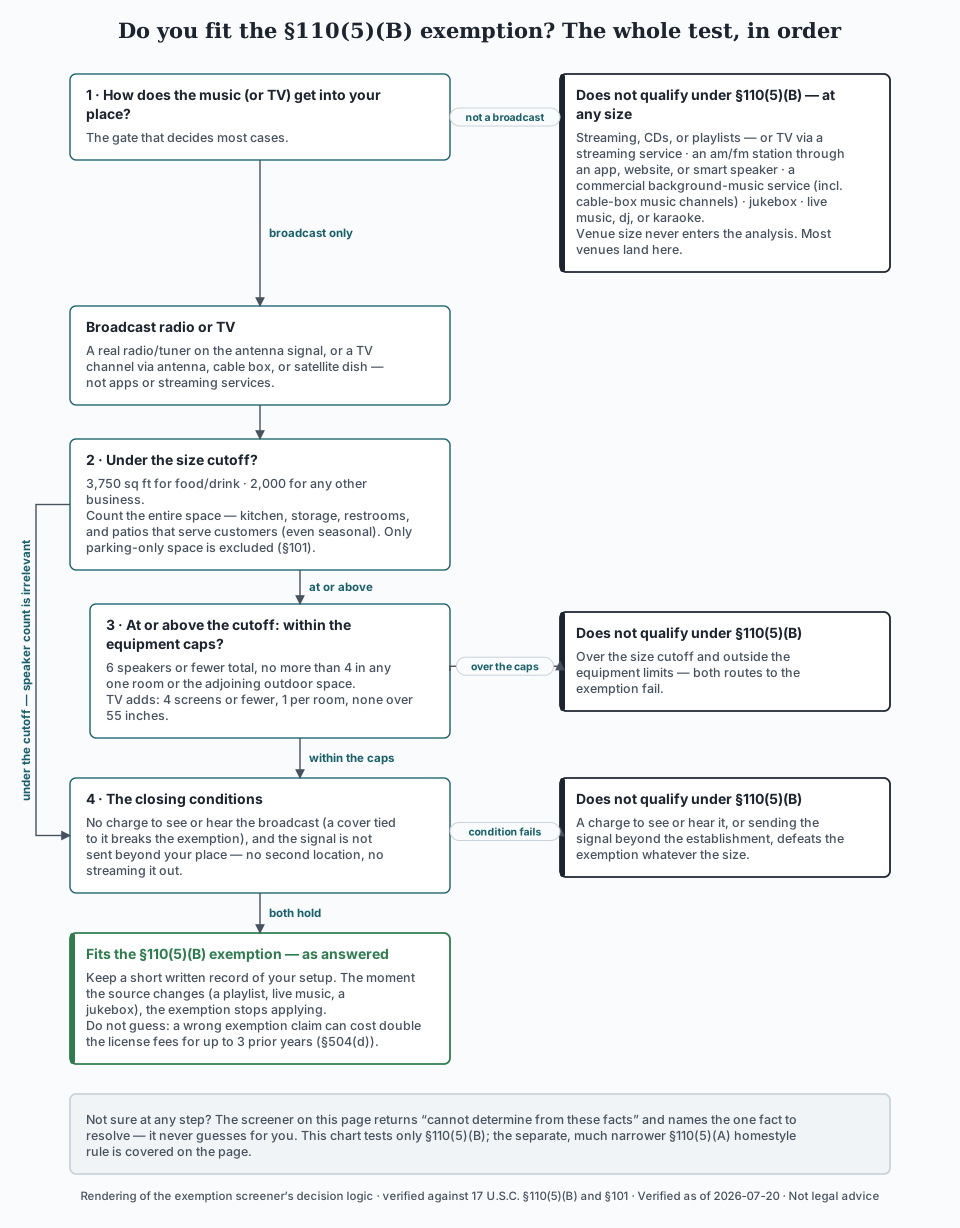
The screener below asks about your music source first — the gate that decides most cases — then your establishment type, size, and the closing conditions. It returns one of three bounded answers: meets the statutory conditions as you answered, does not qualify (and why), or cannot determine from these facts (and what decides it) — always with the facts it rests on and the matching statute language. It produces no output that leaves your browser.
About this check: it runs entirely in your browser. Nothing entered is sent anywhere, stored, or logged. It is free and never gated. It is an educational self-check that decodes the statute and applies it to a general situation. It is not legal advice, and it cannot account for every fact of a specific venue.
In plain language, the same logic reads:
- If your music is not a broadcast radio or TV signal (it is Spotify, Pandora, a background-music service, CDs, a jukebox, live music, or karaoke), you are not exempt under §110(5), whatever your size.
- If your music is a qualifying broadcast signal and you are a food or drink venue under 3,750 gross square feet (or another business under 2,000), with no cover charge to hear it and no re-transmission beyond the premises, you are likely exempt. Keep a short written record of your setup in case a licensing representative asks.
- If your music is a qualifying broadcast signal and you are at or above the size cutoff, you are exempt only if you also stay within the 6-speaker / 4-per-room (and, for TV, 4-device / 1-per-room / 55-inch) limits, with the same no-charge and no-re-transmission conditions.
Special Cases That Live Here
Churches and Nonprofits: Tax Status Is Not a Copyright Exemption
A religious or nonprofit organization is not exempt because of its tax status. The relevant copyright exemptions are narrower. §110(3) covers “performance of a nondramatic literary or musical work or of a dramatico-musical work of a religious nature, or display of a work, in the course of services at a place of worship or other religious assembly.” That reaches music during worship services. It generally does not reach a concert, a festival, or a fundraiser held by the same organization. §110(4) separately exempts certain non-commercial performances “without any purpose of direct or indirect commercial advantage” and without paying the performers, subject to conditions. A church coffeehouse with a paid band, or a nonprofit gala with recorded music, generally falls outside both.
Retail, Salons, and Offices: The 2,000-Square-Foot Branch
A store, salon, or office is not a “food service or drinking establishment,” so its size threshold is 2,000 gross square feet, not 3,750. The rest of the analysis is identical: the exemption still reaches only a qualifying broadcast signal, still requires no cover charge and no re-transmission, and still imposes the equipment caps at or above the size line. A salon playing a streaming playlist is in the same position as a café playing one: outside the exemption regardless of size.
TVs and Sports: Where the Audiovisual Branch Actually Fits
The clearest real-world home of the business exemption is a venue showing broadcast television, because a TV signal delivered by antenna, cable, or satellite is exactly what the statute contemplates. A bar showing a game on a small number of sets, within the device and screen-size limits, is the case where “you may owe nothing” can be honest. The applied version of this, with the audiovisual limits worked through, is covered on the page about television and sports broadcasts.
If You Are Not Exempt, Do Not Guess
The most common expensive mistake is asserting the exemption when it does not apply. The statute has a specific penalty for it. Under §504(d), a proprietor who “claims as a defense that its activities were exempt under section 110(5)” and “did not have reasonable grounds to believe that its use of a copyrighted work was exempt” owes, in addition to ordinary damages, “an additional award of two times the amount of the license fee that the proprietor of the establishment concerned should have paid” for up to the preceding three years. Ordinary statutory damages already run from $750 to $30,000 per work under §504(c). The double-fee provision is a separate, additional cost layered on a wrong exemption claim.
The practical consequence is that a close call is not a reason to stop paying and hope. If your source is recorded, streamed, or live, the exemption is not close; you owe. If your source is a broadcast signal but the size, charge, or re-transmission questions are genuinely uncertain, the safer path is to confirm your position rather than assert a defense you may not be able to support.
What Most Venues Actually Do Next
The honest reading of this statute is that most venues playing music are not exempt, because most play recorded, streamed, or live music that the exemption never reached. That is not a failure of the analysis; it is the answer. For those venues, the useful next questions are what a license actually costs and how to right-size it, and, if a letter has already arrived, how to respond without making the situation worse.
If you have a demand letter in hand, the steps for verifying and responding to it are set out on the page about responding to a PRO demand letter. If you are still working out whether your setup owes at all, the source-by-source breakdown is on the page about whether you even owe. As a starting point on cost: a blanket license for a small venue typically runs from a few hundred dollars to the low four figures per year, per PRO, depending on capacity and how music is used, and each PRO publishes its own rate schedule to verify against. A full breakdown of what a license costs, and which of the four organizations apply, is on which PROs apply and what a license costs. The overview of how a PRO contact works, and where it fits, is on the hub page.
Frequently Asked Questions
What Is the Homestyle Exemption?
The homestyle exemption is §110(5)(A). It allows a single ordinary home-type radio or television receiver to be played in a public place, as long as no direct charge is made to hear it and the signal is not further transmitted to the public. It has no square-footage numbers. It is the “one home radio behind the counter” case, and it does not extend to a wired sound system or multiple speakers. The 3,750 and 2,000 square-foot figures belong to the separate business exemption in §110(5)(B).
Does a Small Restaurant Need a Music License?
It depends on the source, not the size. A small restaurant playing recorded or streamed music (Spotify, Pandora, a background-music service, CDs) needs a public-performance license regardless of how small it is, because that music is outside §110(5). A small restaurant under 3,750 gross square feet playing only over-the-air radio or broadcast TV, with no cover charge and no re-transmission, can be exempt. Live music and karaoke are never exempt.
How Big Can a Bar Be to Be Exempt?
A food or drink establishment can be any size and still be exempt for a qualifying broadcast signal, as long as it meets the equipment limits at or above 3,750 gross square feet. Below 3,750 gross square feet, a qualifying broadcast signal is exempt regardless of speaker count. But the size question only matters if the source is a broadcast radio or TV signal in the first place. A bar of any size playing recorded, streamed, or live music is not exempt.
Does Playing the Radio Really Avoid a License?
For over-the-air radio in a venue under the size threshold, with no cover charge and no re-transmission, §110(5)(B) can exempt it. This is the narrow set of facts the exemption was written for. It stops applying the moment the source changes to a streaming service, a playlist, or live performers, or if the venue charges admission to hear the music or pipes the signal elsewhere.
Is There an Exemption for Playing Original Music Only?
That is a different question from §110(5). Music that is genuinely and entirely owned by the performer, with no covers of any other songwriter’s work and no recorded or broadcast music anywhere in the venue, does not trigger a public-performance obligation, because there is no other rights-holder to license. It is not an exemption under §110(5); it is the absence of a licensable work. The details are covered on the page about live music and original repertoire.